
Mbappe. Haaland. Neymar. And Friegang. Wait, who?
Exactly.
There’s a black hole between the recognition male football players get compared to their female counterparts. Laura Friegang is Germany’s number 10 player at the FIFA Women’s World Cup, which starts in a week. Still, the world seems not to care too much about that.
The battle against stereotypes and cliches these incredible athletes are forced to (still!) face just to get on the pitch and do what they love looks neverending.
“Ponytails” was launched for the 2019 Women’s World Cup, a partnership between the German Federation with Commerzbank. It’s a masterpiece of an ad, from concept to execution, that braves the issue like a proper Gegenpressing tactic—smart, relentless, and from all angles. It was relevant in 2019 but still relevant in 2023.
Let’s break down the idea behind this creative piece made with courage and no balls, literally or figuratively. Just Ponytails.
Since this is the theme, the opening scene is a serious kick in the balls. Alex Popp is the first to ask us, looking straight at the camera, what her name is. She’s followed by Melanie Leupolz and Dzsenifer Marozsán. And crickets. They know we don’t know their names. This moment is pivotal. The script could easily have gone to the old and corny shaming tone with an expected plea for equality in the football world. Nope. As badasses as these women are, they don’t give two scheisse-s about all that. For decades, they played against opponents and clichés. So, at the WWC, it’s business as usual. Kicking ass and not taking names. In 5 seconds, they set the tone of pure creative shithousery.
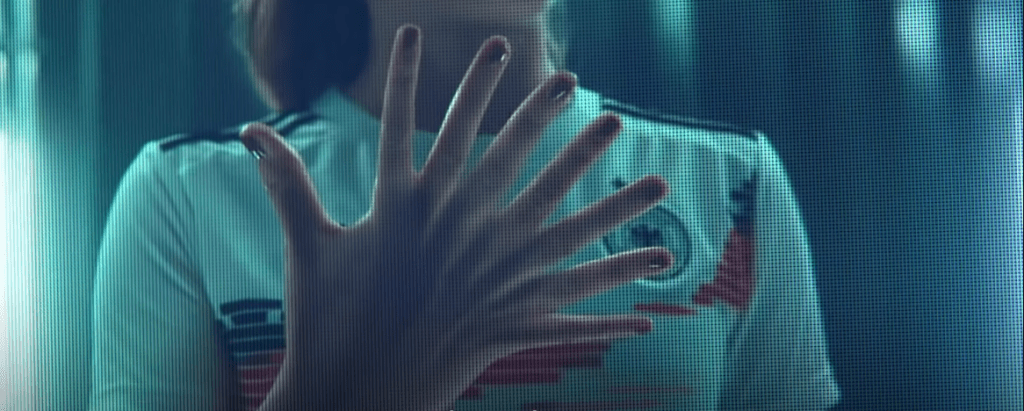
The script structure is simple, with voice-over driving the narrative, presenting then shattering every clichê they had to endure, even as elite players. It toys with the audience. Because you think the embarrassment it’s over after not naming the players. But then, it tricked us into agreeing that they won the Euros 3 times. WRONG. It was 8! A quick shot shows a hand showing 3 fingers, then 8. The surrealness of it reinforces the thought-provoking and playful tone. It looks bizarre, and I love it!
Now, the teacup scene. I mean, WOW. Receiving a teacup set for winning the EUROs is so far-fetched that it feels like a gag from a bad 80s comedy. But it’s even worse because it is real. How do our ladies react? Drinking tea and laughing. The peak of disdain for offenders. All I can say is clapping emoji.
The brilliant storytelling continues with words spoken and images displayed sarcastically, feeding off each. Here, the self-aware nature of the idea allows the cheeky wordplay to work to a tee. Moments like “women are for having babies” or “we are the ones with makeup on our faces,” but what you see is a player celebrating a goal with a belly “pregnant” with a soccer ball and later another player with her face covered by grass and mud.
When we reach about halfway through the film is when it drops the biggest bomb in our laps. The VO says, “We don’t have balls, but we know how to use them.” Damn. So true. So powerful. The nonchalant delivery makes it strong and, yet, graceful—a statement that sums up the journey of many women, not only in football or sports but in life. Having the confidence to carry on for themselves and inspire future generations.
Why does all of this not come off as obnoxious? Because of humor. Great humor. German humor! Let’s take a step back and acknowledge that a German bank spearheaded this. Not the cool kids Nike, Adidas, or Puma. So, for all of us thinking the marketing dept of a German bank has a sense of humor that is below zero, they’re debunking another stereotype. They’re saying the German equivalent: How do you like dem apples?
The film wraps up with a humbling thought that the German squad is OK with their fans not knowing their names. All they want is to get on the pitch and play. The rest is the rest.
Is this 2019 film still held up in 2023? You bet your Pilsen it does. The sad reality of a sport with the potential to be a billion-dollar industry is now being ignored by most brands. There’s this awkward silence about the WWC. The fact that it is happening in Australia & New Zealand made the time zone a scapegoat for low investment in just the-biggest-freakin-women-soccer event in the world. Great job on being on the right side of history. Would that be the case with the men? Ask the rhetorical question. If only they knew you don’t have to grow balls to have them.
 ZUZU F.C.
Leave a comment